Vote for Don Gray ———EBMUD Board of Directors Ward 3
*
Vote for Don Gray ———EBMUD Board of Directors Ward 3 *
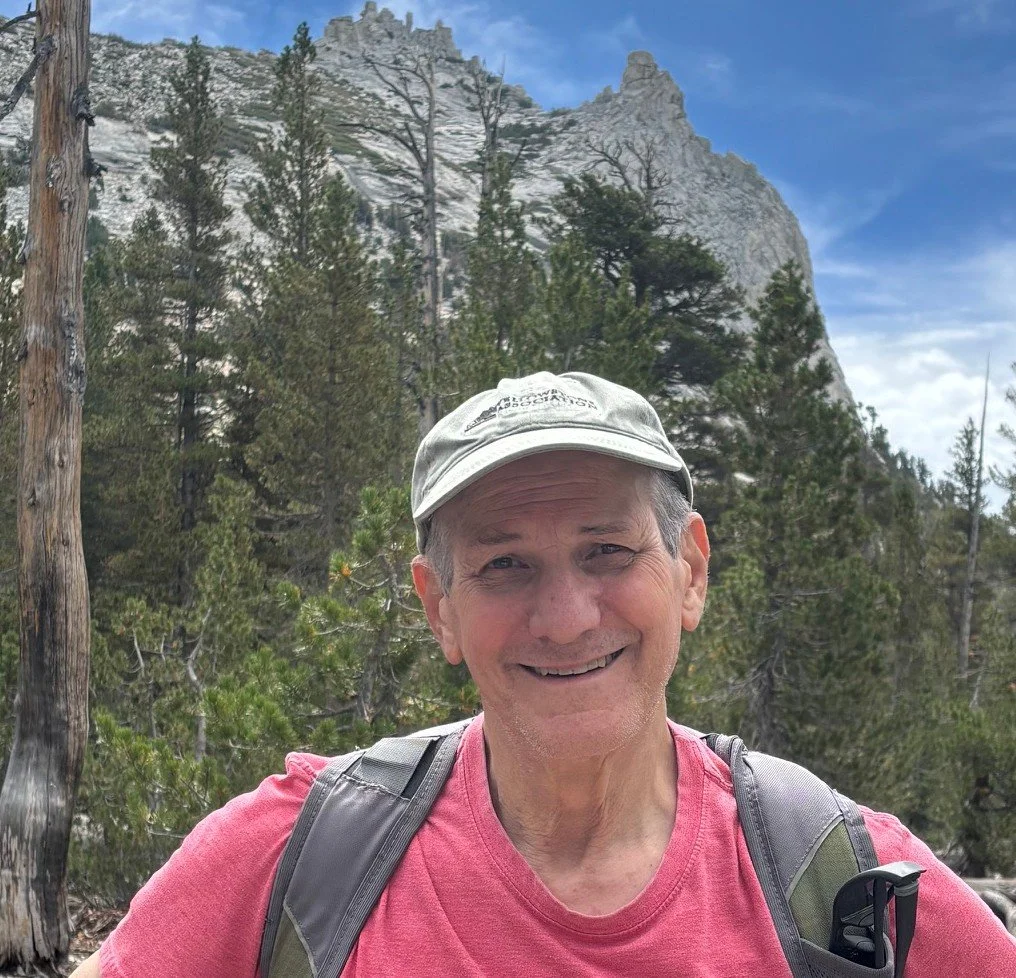
Hello, I’m Don Gray and I’m running for East Bay Municipal Utility District’s (EBMUD) Board of Directors in Ward 3 to ensure high-quality service and the lowest responsible rates to EBMUD customers, using innovative approaches and in-house staff.
I believe the next four years could be very crucial for water agencies. New treatment regulations are appearing on the horizon (such as microplastics in drinking water, and PFAS—called the forever chemicals found in cookware, hiking boots, clothing, marking pens, (etc.) and yes municipal water and wastewater) that will likely be extremely expensive to meet and that could mean a substantial extra financial burden on ratepayers, if we continue to rely on “business as usual.” I have a very different background than what you’ve seen before from those on the EBMUD Board.
I’ve already saved EBMUD billions of dollars during my 30+ years at EBMUD (more below). It’s time for someone with a background like mine to be on the EBMUD Board to help guide the District through the changing regulatory challenges ahead with innovative alternatives—not “business as usual.”
I’ve worked in the municipal water (mostly wastewater) treatment field since age 19, in plants across the US and in Kuwait (for the Kuwaiti Government), South Korea (Yukong Refinery—conceptual design for 9 wastewater treatment plants), and South Africa (University of Cape Town), and at EBMUD for 30+ years, most recently as Manager of Technical and Emerging Issues before retiring.
Before coming to EBMUD I worked for CH2M HILL (now Jacobs) where I was a consultant and lead design engineer for EBMUD’s first major water recycling plant (early 1990s), which provides up to 5.4 million gallons daily to the Chevron Refinery——EBMUD’s largest water recycling plant and one of the largest of its kind in the country.
At EBMUD, I worked closely with many different regulators to create new regulations that reduced treatment cost and your EBMUD bills; obtained 2 patents for first-of-their-kind processes to recycle solid food waste, otherwise landfilled, at EBMUD’s wastewater treatment plant (see below) producing soil amendment and power for the electrical grid; and to operate treatment infrastructure differently, lowering rates; secured grants from government and private organizations to conduct research that saved millions in both operating and capital costs; and developed use of existing facilities to meet new nitrogen (“nutrients”) discharge regulations, instead of spending $2 Billion on new infrastructure that would have very substantially raised rates.
I am a licensed Civil Engineer and Grade 5 Wastewater Treatment Plant Operator in California (one of the first in California to earn both). I was also a Board Certified Environmental Engineer (BCEE) until retirement.
Education:
BS, Environmental Engineering, Cal Poly SLO;
Ph.D., Civil/Environmental Engineering, UC Berkeley;
MBA-Finance, UC Davis (while working full-time at EBMUD)
Innovation
Making EBMUD a leader in the water treatment industry, worldwide—Don Gray made it happen saving EBMUD billions of dollars and providing extraordinary savings for EBMUD ratepayers —see a few examples below:
Before retiring, Don Gray invented a new treatment process that allowed EBMUD to meet its upcoming nitrogen (nutrients) discharge limits using existing treatment infrastructure instead of demolishing existing structures and building the planned all new $2 billion facility that EBMUD would have had to pay for solely with ratepayer (your) money. Don led an all EBMUD team to implement the process full-scale to demonstrate its effectiveness in meeting the upcoming nitrogen requirements.
The U.S. EPA wanted to force all wastewater treatment plants to treat all storm water flows to secondary treatment standards. EBMUD’s wastewater treatment plants currently, then and now, can treat up to about 700+ million gallons per day (MGD) of wastewater to primary standards (includes putting 3 wet weather treatment facilities online in EBMUD’s sewer systems and using large storage basins at EBMUD’s wastewater plant), but only approx. 120 million gallons of wastewater per day to secondary standards (much more expensive to achieve than primary treatment alone). During major storms wastewater treatment plants (including EBMUD) will blend primary effluent (which has been diluted with rainwater entering their collection systems) with secondary treated effluent—called “wet weather blending.” I competed for and won a $700,000 grant to fund a 3+ -year study that I led(collecting an enormous number of plant and San Francisco Bay samples taken during wet weather occurrences, fully analyzing them all, and finally completing microbial risk assessments performed by outside experts with the actual results from all the sampling) to demonstrate that it would be highly unlikely (reasonably impossible) for a swimmer out in the SF Bay during a large storm (even though very, very unlikely someone would be swimming out in the Bay near EBMUD’s discharge pipe under those storm conditions) would be able to swallow enough Bay water to get any kind of infection or illness. The report was published by the Water Environment Research Foundation (now the Water Research Foundation—WER). A few years later the U.S. EPA, determined to write National Blending Regulations to require all U.S. wastewater treatment plants meet full secondary standards even during major storms, called a 2-day conference in 2014 in Fairfax, Viriginia. I was personally invited by the U.S. EPA to be one of 5 Engineering Experts. There were also nine Public Health Experts on the conference panel. After the first day most of the Public Health Experts had given their presentations on why full secondary treatment, even during wet weather flows, was always necessary. It looked like the EPA had what they needed to justify their ban on wet weather blending. I presented EBMUD’s results on the second day. The other experts said they had never seen our results before. Our approach was innovative and convincing, and as a result consensus favored continued wet weather blending. It could have cost $100s of millions in construction costs, if not much more, to comply on those few days when wet weather would be that severe. And even on those very wet days there would be no real benefits to treating all wet weather flows to secondary treatment. Combining this with the nutrient removal process I invented, it would be difficult (and very painful) to imagine what EBMUD’s rates would have to be without them.
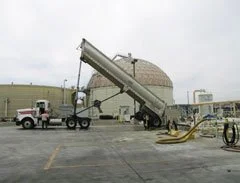
I invented a process that could receive and preprocess food waste to a form that could be pumped to our anaerobic digesters to produce soil amendment and with EBMUD’s engine generators electricity—the electricity generated is used to power the wastewater treatment plant with the excess sold on the electricity grid. Food waste had been a growing concern nationally because very little if any of it had been recycled. Not only did food waste significantly reduce landfill capacity (a growing concern), but it also generated uncontained methane, a potent greenhouse gas which also caused uncontrolled landfill fires. This food waste process was a first ever in the U.S. and as far as we know the world. Now other wastewater treatment plants, like LA County, and landfill operators, use a very similar process. The EBMUD process is shown schematically below, next to a photo of the actual process in action. Further, I also worked very closely with our regulators (Cal Recycle, California Department of Food and Agriculture, and the State Water Resources Control Board) and the California Association of Sanitation Agencies to write new regulations that allows a digester accepting food scraps to be regulated the same as any other Wastewater Treatment Plant digester, saving a lot of money for EBMUD and other treatment plants that came after us.
Other innovations include working with U.S. EPA to obtain Class B standards (suitable for land application) by keeping wastewater and food waste solids in an anaerobic digester for 10 days instead of 15 days by increasing the digester temperature from 35 degrees C to 50 degrees C. This was the first time anyone obtained this designation from the EPA. The designation saved EBMUD $10s of millions by effectively increasing our digester capacity by 50%, and so EBMUD did not have to build more multi-million-dollar digesters. Two of EBMUD’s digesters are featured in the picture below behind the waste hauler’s dump truck, to give a size reference.
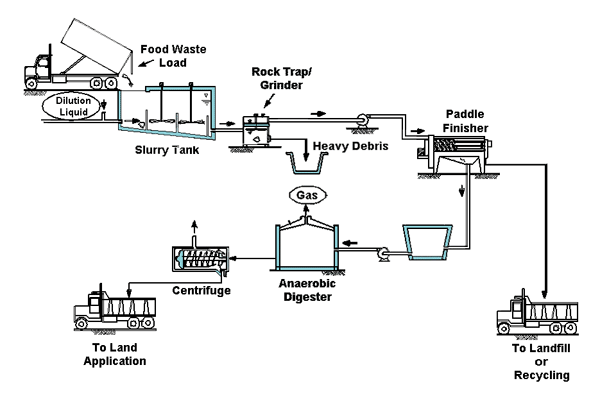
I invented this process (above) and a U.S. patent was obtained for EBMUD. Using this process, EBMUD became the first wastewater treatment plant in the country and probably the world to receive solid food wastes directly and in large amounts to produce soil amendment and electricity. See discussion above.
No Endorsements or Money Requested or Accepted
Candidate websites listing any number of endorsements make me nervous. Do those endorsements mean there is some type of quid pro quo? Can it mean those listed can cut the line and make the ratepayer fund a certain list of special interests? Hope not, but I think you noticed that my website might not be as flashy and professional as other candidates running. That’s because I’m not accepting money or endorsements from anyone for my candidacy. I am the webmaster and this is my first website! I will always listen to anyone who needs me to hear them, and I will always try to help when I can. Nonetheless, if elected you can be sure that I will always put you the ratepayer first, before any special interest.
I’ll keep trying to make my website more attractive and easier to read, but clean water is my purpose, not cool websites.
One personal note. My wife took the picture of me above on our hike to Cathedral Lakes from Tuolumne Meadows earlier this year. My wife and I are getting close to 30 years of marriage, and we have two adult sons.